
The Day Nature Became an Asset
How living systems become economically legible — and why this changes everything

For most of human history, nature did not need to be valued.
It was simply there — surrounding us, feeding us, correcting our excesses without asking permission. Forests made rain. Rivers rearranged landscapes. Soils renewed themselves quietly, beyond notice. Nature functioned as context, not content. As the given.
Value only entered the picture when continuity began to falter.
We noticed it first not through philosophy, but through disruption. Weather stopped behaving statistically. Water cycles grew erratic. Soils tired. Fisheries thinned. Insurance models — of all things — were among the first to register the shift. When risk becomes uninsurable, reality has already changed.
At that point, the question of nature’s value is no longer abstract. It becomes practical, even urgent. What happens when the systems that stabilize life begin to fail faster than we can adapt? What happens when what once absorbed our mistakes starts reflecting them back — amplified?
We value nature now because we have crossed a threshold. From abundance into fragility. From assumption into exposure.
The debate is no longer whether nature should be protected. It is whether human systems can continue without it.
Valuation, awkward as it feels, emerges as a response to blindness. Not because nature is reducible to numbers, but because the absence of numbers made its destruction frictionless. What is not counted is treated as infinite. What is treated as infinite is consumed.
There is always a moment — often late, sometimes too late — when we realize that what we assumed would always be there is no longer guaranteed.
Not gone.
Not yet.
Just thinning.
This is how value enters the room.
Scarcity does not arrive as an argument. It arrives as unease. As a subtle disorientation. A forest that no longer cools the air the way it once did. A river that slows before reaching the sea, as if reconsidering the effort. Seasons that feel slightly misaligned, searching for cues that no longer come on time.
Over the past fifty years, nearly three quarters of terrestrial living systems have disappeared. Half of the ocean’s living fabric has unraveled. These figures are often repeated, yet they resist comprehension. They are too large, too abstract. What they really describe is a narrowing of possibility — a world with fewer buffers, fewer margins for error, fewer quiet systems holding things together while we are not looking.
Scarcity matters because it introduces consequence.
When something is abundant, its loss feels theoretical. When it becomes scarce, every remaining fragment carries weight. Not sentimental weight — functional weight. The kind that determines whether rain still reaches inland fields, whether soils recover after stress, whether food systems bend or break, whether entire regions remain livable.
We tend to think of value as something assigned. A decision. A price. But value often precedes choice. It emerges when absence becomes imaginable. When replacement is no longer obvious. When we sense that some things, once lost, do not return on our schedule — or at all.
Nature now stands at that edge.
Its value does not begin with beauty, though beauty often distracts us into sentiment. It begins with function. Forests move water before they produce timber. Insects pollinate before they decorate fields. Living soils regulate climate long before they grow crops. Biodiversity is not excess. It is the quiet redundancy that allows systems to adapt instead of collapse.
What nature provides is not a collection of services. It is stability. It is continuity. It is the difference between a system that absorbs shock and one that fractures under pressure.
And beneath all of this lies a truth we resist naming:
Nature is not interchangeable.
Once a living system crosses certain thresholds, it cannot be reconstructed. No amount of capital can recreate the intelligence embedded in relationships formed over millennia. Species loss is not just subtraction. It is erasure — of memory, of possibility, of futures that will never arrive.
This irreversibility is the deepest source of nature’s value. Not because it makes nature sacred, but because it makes loss final.
Somewhere along the way, nature stopped being the backdrop and became the condition. What once framed human activity now shapes whether it can continue at all. Forests are no longer scenery. Rivers are no longer amenities. The systems we treated as given have become structural, and with that shift comes something harder to avoid than admiration or concern: Responsibility.
Scarcity does not ask us to love nature more.
It asks us to notice what happens without it.
And that noticing — uncomfortable, destabilizing — may be the first honest step toward understanding what nature is actually worth.
I- What Nature Actually Does — and How We Forgot How to See It
For a long time, we praised nature for the wrong reasons.
We spoke about beauty. About wilderness. About preservation. We learned to admire landscapes from a distance, or to defend them once damage had already occurred. Nature became something scenic, something moral, something optional. What quietly disappeared from view was function.
Nature works.
Not symbolically. Not metaphorically. In the most literal sense. It performs labor — continuously, redundantly, without instruction. Whether we notice or not.
Forests do not simply stand in place. They move water. Through evapotranspiration, they lift moisture from soil to sky, shaping rainfall patterns hundreds of kilometers away. When forests thin, rain does not politely resettle elsewhere. It falters. Agriculture notices first. Cities follow later.
Pollinators are not ornaments of spring. They are infrastructure. Without them, entire food systems unravel — not slowly, but abruptly. The technologies proposed to replace them remain largely theoretical. Nature’s version runs on sunlight, timing, and relationship, refined through evolutionary trial rather than design.
Soils, too, have been misunderstood. We treat them as surfaces, as inert platforms for production. In reality, they are living architectures — dense microbial networks that regulate carbon, nitrogen, moisture, and temperature. When soils are alive, extremes soften. When they degrade, volatility follows. Floods intensify. Droughts linger. Productivity becomes brittle.
What nature provides is often described as a set of services. This language misses the point. Nature does not offer add-ons. It provides stability. It provides continuity. It creates the conditions under which shocks can be absorbed rather than transmitted.
Biodiversity plays a central role here, though it is often misunderstood. It is not decoration. It is not surplus. It is redundancy — the quiet overcapacity that allows systems to adapt when conditions change. Simplified systems perform efficiently under stable conditions. They fail quickly under stress. Complexity is what keeps failure from cascading.
We are accustomed to thinking of resilience as something to be engineered. But most resilience was already built — slowly, relationally, beyond any single intelligence. We inherited it. We spent it. Only now are we beginning to calculate what it would cost to live without it.
This is why nature’s value is now becoming visible — not because we have grown wiser, but because failure has become harder to ignore. Crop yields wobble. Water tables sink. Fire seasons stretch. Insurance retreats from regions once considered stable. The margins that absorbed our mistakes are thinning.
Nature is not a luxury. It is the operating system.
And systems, once destabilized, do not negotiate.
They respond only to physics, biology, and time.
What we are confronting is not the loss of beauty, though beauty will follow. It is the erosion of function — the slow breakdown of processes we relied on precisely because we did not have to think about them.
Seeing nature clearly again does not require reverence.
It requires attention.
And attention, once restored, changes what responsibility begins to mean.
II- The Carbon Shortcut
We did not begin by misunderstanding nature.
We began by reacting to danger.
Climate change arrived faster than our institutions were built to respond. It did not ask for nuance. It demanded action — immediate, scalable, legible action. Carbon offered something rare in that moment: a handle.
A molecule that behaved predictably. Something that could be counted, priced, regulated, and traded.
This was not cynicism. It was triage.
A hectare could absorb a measurable amount of CO₂. A project could be evaluated. Targets could be set. Capital could move. In systems trained to respond only to what can be quantified, carbon became a bridge between ecology and economics. For the first time, nature entered the spreadsheet.
That mattered.
It mattered because it made inaction visible. It mattered because it created accountability where none had existed. It mattered because it forced climate into rooms where it had previously been dismissed as external.
But carbon also taught us how to look away.
By reducing nature to a molecule, we learned to see ecosystems as containers rather than processes. Forests became storage units. Landscapes became accounting surfaces. A fast-growing monoculture could outperform a complex forest on paper. A eucalyptus plantation could look better than a rainforest — at least in the language of tons and timelines.
Carbon does not ask how water moves.
It does not notice pollinators falling out of sync.
It does not distinguish between living soil and compacted dirt.
This is not a failure of carbon itself. It is a failure of reduction.
The carbon shortcut was powerful precisely because it was incomplete. It allowed action without requiring understanding. That made it scalable. It also made it dangerous. What began as a tool gradually hardened into a worldview. Climate mitigation became the objective, rather than ecological health. We optimized for what could be measured cleanly, not for what allowed systems to remain viable.
The deeper functions of nature — adaptation, recovery, resilience — slipped back into invisibility. We mistook storage for stability. We confused slowing damage with restoring capacity.
Carbon is not wrong. It is simply insufficient.
It tells us something important, but not enough to guide stewardship. It measures a symptom of imbalance, not the condition of the organism. And when systems are already under strain, treating symptoms as proxies for health can accelerate collapse rather than prevent it.
The carbon shortcut bought us time.
It did not buy us understanding.
And time, as we are learning, is not the same thing as safety.
What comes next requires a different way of seeing — one that does not abandon measurement, but deepens it. One that moves beyond counting molecules toward understanding living systems.
That turn is already underway.
III- When Finance Finally Looked Down
The shift did not begin with conviction.
It began with exposure.
For years, ecological damage could be discussed as an externality — real, regrettable, but safely outside the core mechanics of the economy. That separation held as long as nature appeared stable. What changed was not belief, but reliability. Systems once assumed to be background conditions started behaving like variables.
Some of the first institutions to notice were not environmental organizations, but financial ones.
In a widely cited analysis, UBS stated plainly that close to 60 percent of global GDP is moderately or highly dependent on nature — not on climate in the abstract, but on functioning ecosystems: soil fertility, water availability, pollination, flood protection. This was not framed as ethics. It was framed as dependency.
That distinction mattered.
It suggested that nature was not an external concern to be managed after the fact, but a structural condition underlying economic activity itself. Large portions of the global economy, it turned out, were quietly leveraged to systems that were degrading faster than financial models assumed. What had long been treated as environmental risk began to look like systemic economic risk.
Politics followed, cautiously.
In 2022, nearly every nation on Earth — 196 countries — signed the Kunming-Montreal Global Biodiversity Framework. The language was careful, even restrained, but the implication was not. Biodiversity loss was no longer described as an unfortunate side effect of development. It was acknowledged as a threat to food security, economic stability, and long-term growth itself.
Law began to adjust accordingly. In the United Kingdom, biodiversity ceased to be treated solely as damage to be minimized. The Biodiversity Net Gain, a new planning requirement asks something more direct: that development leave ecosystems measurably better than before. Nature entered permitting processes not as sentiment, but as constraint.
Capital moved next.
Goldman Sachs launched a half-billion-dollar strategy focused on nature-based solutions, framing ecosystem restoration not as philanthropy but as risk-adjusted investment. BlackRock followed with its own nature-aligned investment strategies. Large asset managers began linking exposure to land, water, biodiversity, and resilience — not because nature had become fashionable, but because it had become material.
Insurance companies noticed even faster. They always do. When wetlands disappear, floods stop behaving statistically. When forests thin, fires escape historical bounds. When risk can no longer be priced, it withdraws.
This was not a collective change of heart.
It was recognition.
Nature, long assumed to be stable, revealed itself as the least diversified asset on Earth. Once that becomes visible, treating it as infinite is no longer compatible with fiduciary responsibility.
The awakening is not poetic.
It is actuarial.
And once finance understands that its own survival was entangled with living systems, nature can no longer remain off the books.
IV- The Trouble With Measuring Life
Once nature re-enters the economic conversation — not as sentiment, but as dependency — a practical question follows almost immediately.
How do you measure it?
Not symbolically. Not rhetorically. In a way that can withstand regulation, capital allocation, and accountability.
Carbon has made this feel deceptively simple.
Carbon behaves. It reduces cleanly to a molecule, a unit, a ton. It moves through equations without friction. Biodiversity does not. Soil health refuses to sit still. Water cycles cross boundaries. Relationships — between species, between land and people — do not repeat themselves on schedule.
Life is not additive.
You can count trees and still miss the forest. You can tally species and miss the collapse of interaction. You can optimize yield while the system’s ability to recover quietly drains away. The qualities that make ecosystems viable — their capacity to regenerate, to adapt, to absorb shock — do not appear in snapshots. They reveal themselves only over time, and only in context.
This creates a problem for systems built on legibility.
What cannot be measured consistently cannot be governed. What cannot be governed is treated as external. And what remains external is eventually consumed — not out of malice, but because invisibility carries no cost.
The difficulty here is not only technical. It is conceptual. Modern decision-making systems are trained to evaluate outcomes rather than processes, stocks rather than flows. Nature does not cooperate with that logic. It is always becoming something else. Health, in living systems, is not a fixed state.
It is a direction.
To measure nature, then, is not to freeze it. It is to observe its trajectory. Is the system building capacity or losing it? Is diversity deepening or thinning? Are feedback loops strengthening in ways that support life, or unraveling in ways that make collapse more likely?
These are not questions with single answers. They resist simplification. They demand patience — and tools capable of holding complexity without flattening it.
That is the threshold we have reached.
V- What It Means to Measure a Living System
Carbon felt manageable because it allowed distance.
You could measure it without understanding the system that produced it. You could count carbon and remain largely blind to life — and for a time, that blindness felt efficient.
Nature does not permit that separation.
Biodiversity is not a thing; it is a pattern. Soil health is not a metric; it is a relationship. Water cycles, resilience, adaptability — these are not outputs that can be isolated without disturbing what one is trying to observe. They are properties that emerge only when a system is allowed to function as a system.
Pull them apart, and the signal collapses.
And yet, without some form of measurement, nature remains functionally invisible to the institutions now shaping its fate. This is the paradox at the center of the moment: what most needs to be valued is precisely what our tools have been least capable of seeing.
We became adept at measuring what is static and missed what is alive. We optimized for snapshots while the process continued — often toward degradation — outside the frame.
Measuring a living system therefore requires a different posture.
It means shifting attention from parts to coherence, from stocks to flows, from outputs to capacity. It means asking not whether an ecosystem appears intact at a given moment, but whether it is becoming more capable of sustaining life over time — or less.
Health, in this sense, is not a score.
It is a trajectory.
This kind of measurement does not promise control. It does not deliver certainty. It offers orientation. A way of noticing whether feedback loops are tightening or unraveling, whether diversity is accumulating or being simplified, whether resilience is being built or quietly spent.
Approaches like SEVA’s Aliveness Index enter here not as final answers, but as attempts to make vitality legible without flattening it — to observe direction rather than perfection, to register whether a system is regenerating, holding, or eroding.
This is not measurement as surveillance. It is measurement as listening.
You cannot protect what you cannot perceive.
And you cannot steward what you do not understand.
What follows is not a philosophical leap, but a technical one: how this way of seeing becomes possible at scale — without turning life back into an object once again.
VI- Learning to See Systems, Not Snapshots
The measurement problem does not resolve itself through better intentions.
It resolves only when the instruments change.
Over the last decade, the way ecosystems can be observed has shifted in a material way. This is not a conceptual reframing. It is a technical development.
Bioacoustic sensors now record entire soundscapes, allowing researchers to infer ecosystem condition through the presence, absence, and timing of species interactions. Environmental DNA sampling identifies organisms through genetic traces in soil and water, revealing biodiversity without requiring direct observation. Camera traps capture movement, behavior, and interaction rather than isolated sightings.
What these tools produce is not simply more data.
They produce relational evidence.
Ecosystem degradation rarely begins with everything disappearing at once. It begins with desynchronization. Pollinators arrive at the wrong time. Predators vanish. Soils lose microbial diversity. Water flows fragment. The system may still look intact, but its internal relationships are weakening. These shifts are subtle, but they are detectable — if one is looking for patterns rather than counts.
At the same time, the cost of sensing complexity has fallen dramatically. What once required years of fieldwork can now be observed continuously, across large landscapes, in near real time. This makes it possible to monitor ecosystems not as static inventories, but as evolving systems — systems with memory, momentum, and thresholds.
Artificial intelligence enters here not as a replacement for ecology, but as a means of integration.
Modern Agentic AI systems increasingly rely on agent-based models capable of updating their internal representations as new information arrives. This approach aligns closely with the Free Energy Principle, articulated by Karl Friston, which describes how living systems maintain viability by reducing surprise — by continuously refining their internal models of the world through perception and action.
Applied to ecosystems, this logic enables what is known as active inference.
Active inference does not treat intervention as control. It treats it as learning. A system observes, acts, registers consequences, and adjusts. Rather than reacting only after degradation becomes visible, it allows scenarios to be explored in advance — testing how changes in land use, species composition, or management practices alter long-term trajectories.
This is the role of the digital twin.
A digital twin is a continuously updated digital representation of a real ecosystem, grounded in sensor data, ecological understanding, and contextual knowledge. It does not predict a single future. It explores many plausible ones. It can distinguish between trajectories that build resilience and those that quietly erode it. It can detect early signals of entropic decline or syntropic recovery before thresholds are crossed.
The significance here is practical, not speculative.
Digital twins allow conservation, restoration, and productive systems — such as agroforestry — to be managed as adaptive processes rather than fixed plans. Decisions become iterative. Assumptions can be tested. Interventions can be reversed before damage becomes irreversible.
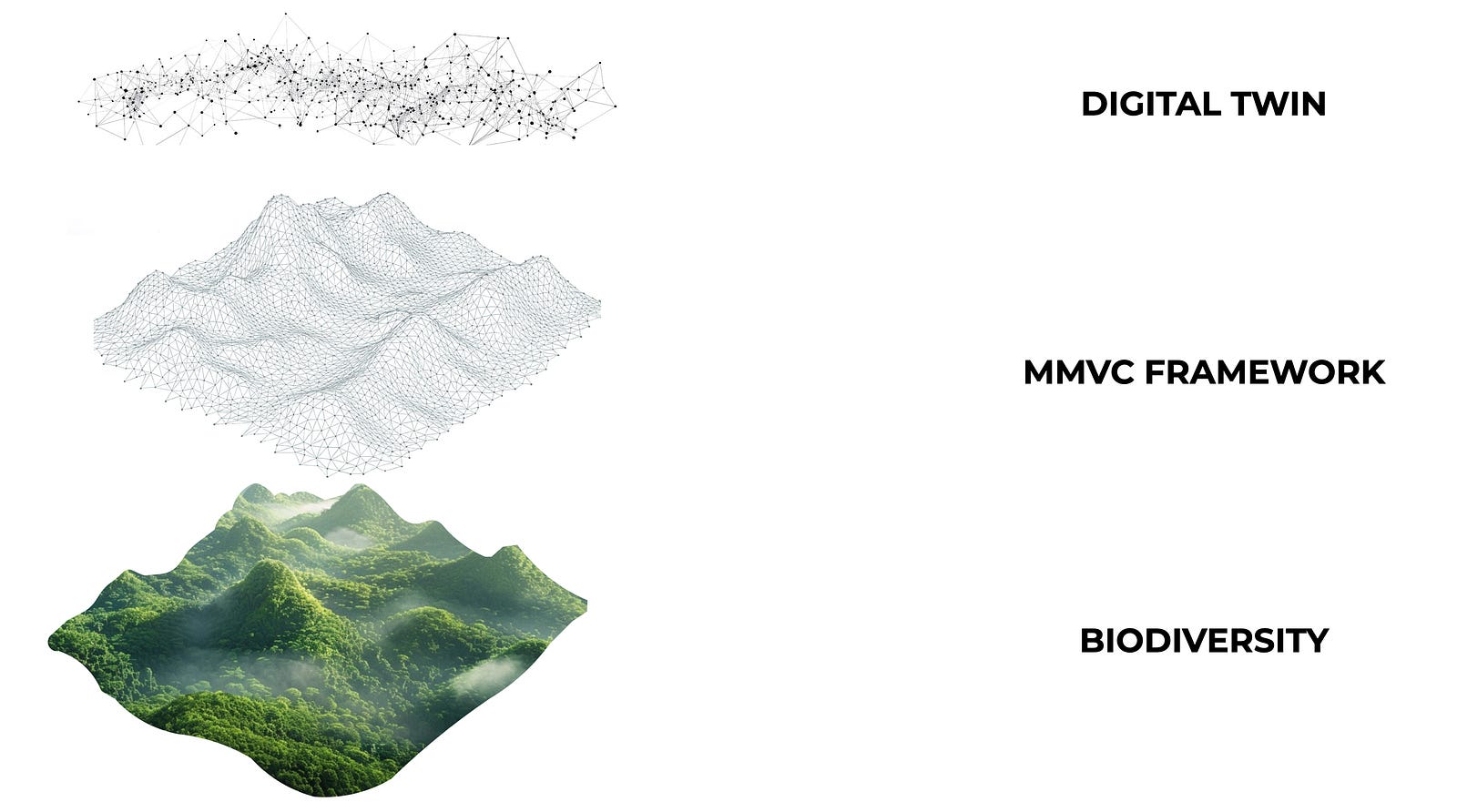
MMVC stands for Measuring, Monitoring, Verifying, and Certifying. It is a framework designed to make living systems legible without flattening them. MMVC tracks how an ecosystem is functioning over time — ecologically, biologically, and socially — by observing processes rather than isolated metrics. The goal is not control, but orientation: understanding whether a system is regenerating, stabilizing, or degrading, and providing credible evidence of that trajectory for stewardship, governance, and investment.
This is not about controlling nature.
It is about reducing blindness.
For the first time, the complexity of living systems can be observed, interpreted, and responded to with a level of coherence that approaches the scale of the challenge itself. The question is no longer whether we have the capacity to see ecosystems as living systems.
It is whether we are prepared to act on what they are telling us — without mistaking listening for command.
VII- From Measurement to Living Capital
Once an ecosystem can be observed as a system — its trajectories followed, its resilience assessed, its degradation detected early — it crosses an important threshold.
It becomes legible.
Legibility is not a moral achievement. It is a functional one. What can be observed consistently can be compared over time. What can be compared can be evaluated. And what can be evaluated enters decision-making structures that have, until now, treated most of life as external.
This is the moment where unease sets in.
The digital twin of an ecosystem does not merely describe conditions. It establishes a baseline of ecological vitality and tracks how that vitality changes. A degraded landscape shows thinning diversity, broken connectivity, fragile soils, unstable water dynamics. A regenerating ecosystem shows the opposite: strengthening relationships, increasing redundancy, growing capacity to absorb disturbance.
These differences are not interpretive. They are observable. And they matter.
When ecological condition can be followed longitudinally, ecosystems begin to resemble what modern finance would recognize as assets — not because they can be extracted, but because they can endure. Floodplains reduce downstream losses. Living soils stabilize yields. Biodiverse systems soften shocks that simplified systems amplify.
This is where the idea of living capital takes shape.
Living capital is not land ownership. It is not speculation on future scarcity. It is the accumulated capacity of a living system to sustain life over time. When that capacity grows, the underlying value grows. When it erodes, value diminishes — quietly at first, then abruptly.
A nature-based currency is simply an instrument indexed to that reality.
Its value does not sit still. It evolves with the health of the ecosystem it represents. As biodiversity deepens, as soil function improves, as water cycles stabilize, the living capital strengthens — and so does the value attached to it. When degradation returns, value declines. Not because of sentiment or volatility, but because the system itself has become less viable.
This introduces a feedback loop that has been largely absent from finance.
Capital begins to favor regeneration because regeneration improves asset quality. Conservation is no longer framed as sacrifice. Restoration ceases to be a sunk cost. Stewardship actions — repairing connectivity, reintroducing keystone species, adjusting land use — become investments in long-term viability rather than external interventions.
For financial institutions, this creates exposure to something different: resilience rather than throughput. For insurers, it offers a way to reduce systemic risk before loss becomes unavoidable. Healthier ecosystems fail less catastrophically. They buy time.
This does not mean markets will save nature.
It means markets are already shaping outcomes, whether we acknowledge it or not. The question is not whether value will be assigned, but what it will point toward.
Nature is already valued — by being depleted.
The possibility here is modest but meaningful: that value might begin to align, even partially, with the conditions that allow life to continue.
VIII- The Moral Edge of Valuation
This is where many readers hesitate.
Once nature becomes legible — once ecosystems are measured, modeled, and translated into forms finance can recognize — a familiar unease surfaces. Have we not been here before? Turning living systems into assets. Translating relationship into instrument. Mistaking clarity for permission.
The concern is not theoretical. It is historical.
Again and again, tools developed to protect have been repurposed to dominate. Maps became claims. Metrics became mandates. Management replaced relationship. The danger is structural: any system powerful enough to steer outcomes is also capable of overriding humility.
I feel this tension directly.
Because there is no longer innocence in simply “leaving nature alone.” The economic system we inhabit — the global metabolism of extraction, conversion, and accumulation — does not pause for reverence. It continues to simplify and consume whether we intervene or not. Refusing to engage does not preserve nature. It leaves it exposed.
So the ethical question is not whether we touch nature.
We already do.
The question is how.
The difference between domination and service does not lie in the sophistication of the tool. It lies in orientation. Control seeks predictability. Stewardship seeks viability. Control asks how to optimize performance. Stewardship asks how to remain in relationship.
This distinction matters more than precision.
If valuation becomes another layer of command — directing ecosystems toward narrow targets, optimizing them for financial legibility — then nothing essential has changed. We will have built a more refined apparatus of control. A greener version of the same mistake.
But if valuation functions instead as a nutrient — circulating resources in ways that strengthen the capacity of ecosystems to organize themselves — then the posture shifts. Finance ceases to be a driver and becomes a supporter. Capital moves not to extract value, but to sustain the conditions under which value continues to emerge.
Nature does not need to be managed.
It needs to be allowed to do what it already knows how to do.
This is where commons thinking becomes more than theory. Elinor Ostrom demonstrated, through careful observation rather than ideology, that shared resources can be stewarded without central domination when governance aligns incentives with long-term care. In such systems, humans do not command outcomes. They tend conditions. They listen, adjust, and intervene only when feedback demands it.
Valuation, in this frame, is not a claim of ownership. It is a language of responsibility. A way of making visible what our institutions otherwise erase — not because life conforms to markets, but because markets already shape the fate of life regardless.
Our civilization as caught inside a self-consuming loop, an ouroboros devouring its own tail. That system will not be persuaded by ethics alone. It responds to incentives, constraints, and signals.
The moral task, then, is vigilance.
To ensure that measurement does not harden into command.
That modeling does not replace listening.
That finance remains a servant, never a master.
This approach does not resolve the ethical dilemma.
It holds it — deliberately.
Because the greater danger is not that we might align imperfectly with nature.
It is that, fearing imperfection, we allow the existing system to finish what it has already begun.
To be in service of nature today is not to withdraw.
It is to engage — with restraint, with humility, and with the courage to stop when alignment is lost.
That posture may be the most human one still available to us.
IX- From Ownership to Stewardship
What comes before is an effort to see living systems again. What follows asks what kind of posture that seeing now demands.
For most of modern history, economic organization has revolved around ownership — clear boundaries, exclusive rights, transferable control. That logic proved effective for things that do not regenerate, or that regenerate slowly enough to be treated as inert. It works poorly for living systems whose value depends on continuity, relationship, and time.
Nature resists ownership even when titles exist.
Water ignores borders. Species migrate. Climate circulates. What appears manageable at the parcel level behaves very differently at the system level. This mismatch is not philosophical. It is operational. It produces leakage, collapse, and unintended consequence.
The question, then, is not who owns nature, but how something that cannot be fully owned can be responsibly tended.
This is where stewardship replaces possession as a more accurate description of the task.
Stewardship is not a moral upgrade. It is a functional necessity.
Living systems require care that responds to feedback, adjusts over time, and preserves complexity rather than simplifying it away.
Commons-based governance offers a clue. Not as nostalgia, but as infrastructure. Where commons function, they do so through shared rules, monitoring, accountability, and a clear understanding that the health of the resource and the well-being of its users are inseparable. Complexity is not tolerated despite the system. It is preserved because of it.
A forest treated as a commodity will tend toward simplification.
A forest stewarded as a commons must remain complex to survive.
This is not preference. It is ecology.
When finance is placed in service of stewardship rather than extraction, the shift is subtle but decisive. Returns are no longer maximized by depletion, but by continuity. Risk is reduced not only through diversification, but through resilience. Value accumulates not by accelerating turnover, but by sustaining the conditions that allow regeneration to continue.
Stewardship, in this sense, is a form of intelligence.
It is not passive protection. It is active participation in feedback loops — listening, adjusting, intervening when signals demand it. It is closer to tending than managing, closer to learning than commanding.
The tools described earlier — measurement, digital twins, active inference — only make sense within this posture. Without it, they become instruments of optimization. With it, they become instruments of care.
X- Taming the Super-Organism
Every civilization eventually confronts the same realization: it has built something larger than itself.
Not a machine. More like a metabolism.
A dense web of incentives, expectations, obligations, and momentum that no single actor controls, yet everyone participates in. It rewards speed. It favors scale. It converts future stability into present advantage. And once it reaches sufficient size, it becomes difficult to interrupt — not because people are malicious, but because the system penalizes restraint.
This is the super-organism we now inhabit.
It does not respond to ethics.
It responds to signals.
Left to itself, it behaves predictably — extracting, converting, accelerating — until the conditions that sustain it begin to fail. History suggests that such systems do not correct through awareness alone. They adjust when constraints become unavoidable. Often, that adjustment arrives as collapse.
The uncomfortable question is whether collapse is the only regulator left.
The approach outlined in this essay does not imagine dismantling the super-organism. That would be fantasy.
It proposes something narrower and more plausible: redirection. If the system organizes itself around value, then value must be reoriented toward continuity rather than depletion.
This is why measurement and valuation matter — not as solutions, but as levers.
They allow signals to change.
When regeneration becomes investable, capital slows down. When ecosystem health reduces risk, insurance models shift. When stewarded systems outperform degraded ones over time, extraction loses its advantage — not because it has become unethical, but because it has become inefficient.
This is how large systems tend to change.
Not through persuasion.
Through pressure.
The super-organism is adaptive. It will search for shortcuts. It will attempt to simplify what should remain complex. It will try to extract value even from regeneration itself. This is not a reason for cynicism. It is a reason for vigilance — not ideological purity, but institutional learning.
The aim is not to civilize the system completely.
It is to keep it from consuming the conditions of its own survival.
If finance can be made — even partially — to circulate like a nutrient rather than a solvent, the odds shift. Not toward resolution, but toward endurance.
And endurance, in a moment like this, is not a small ambition.